|
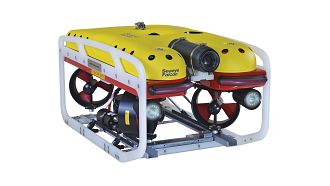
Seaeye Falcon & Seaeye Falcon DR


Seaeye Falcon - 300 m depth rated
|
|
Seaeye Falcon Features:
- 300 metre depth rating, 14 kilo payload
- Max 450 metre umbilical (1100 metres with F2 Fibre
Optic Pack)
- Magnetically coupled brushless DC thrusters with velocity
feedback loop
- 4 Vectored and 1 vertical thruster
- 50 kgf thrust with 1:1 power to weight ratio
- Distributed intelligence control system
- Integral system diagnostics
- High resolution colour camera on 180° Tilt Platform
- Variable intensity, 6400 Lumens of LED lighting
- Auto heading, depth, compass and rate gyro
- Portable surface control system with video overlay
and daylight readable display
- Low drag umbilical
- Single phase A/C power input - auto selecting universal
100-270 VAC at 2.8 kW

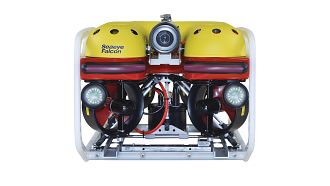
Seaeye Falcon DR - 1000 m depth rated
Note higher density buoyancy and tilting fwd lights |
The Falcon DR offers the additional capability
of:
- 1000 m depth rating
- 1100 m umbilical length with 14 mm diameter umbilical
- longer options available with custom umbilicals
- Tilting variable intensity LED lights linked to camera
tilt mechanism
- F2 fibre optic data and video transmission system
| Video |

Play |
Size |
10.9 MB |
| Resolution |
375 X 288 pixels |
| Duration |
4 minutes |
| Format |
MPEG |
Best viewed
with Windows Media Player ( free
download from Microsoft )
You may also download by right-clicking icon and selecting
'Save Target As'.
Warning! This
is a BIG file. Having ISDN, ADSL or faster is recommended. |
| |
Introduction
Between 1986 and 2002 when the first Seaeye
Falcon was delivered, the company's focus had been to develop
and support a range of ROV systems from the observation class
Seaeye Tiger to the work Class Panther Plus for the offshore
oil and gas industry and to maintain its leading position
in that market by constantly seeking new ways to get more
work out of these light, powerful systems.
With the introduction of the Falcon in May
2002 the company was to bring the knowledge and experience
it had developed in this most demanding environment to other
users requiring the professional capability and reliability
associated with Seaeye ROVs but in a portable package built
to a tighter budget. The arrival of Falcon introduced a number
of interesting innovations in an ROV of this size and price
range including the replacement of the ROV electronics pod
with a distributed intelligence control system and new high
torque magnetically coupled brushless DC thrusters.
 |
|
 |
| Falcon operations though the ice in Canada |
|
Fish farming in Australia with a successful
prototype mort removal scoop |
Today, Falcon customers include several NATO
navies, the Russian, Chinese, Rumanian and New Zealand Navies
as well as Special Forces in the Middle East. The ease with
which tools and sensors can be added to this modern open frame
vehicle without upsetting its performance and stability has
also found favour with scientists, environmental groups, civil
engineers and deep penetration internal tunnel surveyors.
 |
|
 |
| Falcon with F2 Fibre Optics to accommodate
1100 umbilical, inertial navigation, video and survey
data in Saudi Arabian tunnel |
|
Virtual tunnel created by CDL software
following survey using this package. Each 360 degree profile
is joined up to create a virtual fly through |
Many improvements have been incorporated
since the system was first introduced. Nearly all are backwardly
compatible with earlier systems and include:
- 2003 Colour camera upgraded from 1/3
CCD to higher resolution ½ CCD Seaeye Camera.
- 2003 F2 Fibre optic multiplexer upgrade
option introduced for Falcon (later to become standard fit
in Falcon DR).
- 2003 Controls for 2 extra lights and
camera zoom focus made available.
- 2003 Auxiliary hand controller introduced
to control 2 x zoom focus cameras and aux lights and/or
Tritech Laser scaling camera.
- 2004 Software provided to control
optional second camera tilt mechanism (usually skid mounted).
- 2004 Software for full/reduced thruster
power select switch modified to allow max power to each
axis to be individually set in start up routine.
- 2005 Improved compass provided in
navigation pod providing 3x improved accuracy. (Max error
reduced from 4 degrees to 1 degree).
- 2005 Pitch and Roll sensor incorporated.
Can be deselected.
- 2005 Tolerances in thruster gearboxes
improved for smoother running & longer life.
- 2006 1000 metre rated Seaeye Falcon
DR introduced.
- 2006 New, lighter Surface Control
Unit introduced with fold out flat screen display, new switch
mode supplies housed in a shock mounted military style case.
The Seaeye Falcon DR was introduced
in 2006 following a number of successful operations conducted
by Chris Bryant of Subsea
Vision with a standard Falcon upgraded to a specification
that would form the basis of the new system. Subsea Vision's
requirement was to penetrate 1600 metres into a pipe line
running 600 metres down a mountain side in a hydroelectric
scheme. In order to transmit video and data over this length
of umbilical it was necessary to add the F2 Fibre optic pack
to his Falcon. This had previously been proven in operations
to inspect tunnels in Saudi Arabia with a Falcon fitted with
inertial navigation and in Falcons fitted with broadcast quality
cameras. The F2 fibre optics package provides a fibre optic
multiplexer in the vehicle and in the surface unit as well
as fibres in the umbilical. It was also necessary for this
operation to increase the depth rating of many of the components
used in a standard Falcon beyond 300 metres and 1000 msw was
chosen.
 |
|
 |
| Falcon DR with flood light tilt linked
to camera tilt |
|
The four vectored horizontal thrusters |
The Falcon DR is rated for operations
to 1000 metres to cater for similar operations in deep tunnels
as well as for fly away operations in deeper water offshore.
(For regular operations needing a TMS, the Seaeye Tiger may
be more appropriate) This Deeper Rated Falcon DR is
easily recognised by the thicker red higher density buoyancy
material visible below the removable yellow top faring. Another
recognisable external feature is the forward facing tilting
flood lights that are linked to the camera tilt platform to
provide improved scene illumination when filming above or
below the vehicle centre line. The Falcon DR camera
tilt motor and chain drive is the same unit used in the Seaeye
Tiger.

THE VEHICLES
| Vehicle Specifications |
Seaeye Falcon |
Seaeye Falcon DR |
| System Power Requirements |
Single Phase 100-270 VAC at 2.8 kW |
| Maximum Umbilical Length |
450 m |
1100 m |
| Depth Rating |
300 msw |
1000 msw |
| Length |
1000 mm |
1055 mm |
| Height |
500 mm |
635 mm |
| Width |
600 mm |
600 mm |
| Launch Weight |
60 kg |
100 kg |
| Forward Speed |
> 3 knots |
> 3 knots |
| Thrust Forward |
50 kgf |
50 kgf |
| Thrust Lateral |
28 kgf |
28 kgf |
| Thrust Vertical |
13 kgf |
13 kgf |
| Payload |
14 kg |
15 kg |
| |
| |
 |
|
 |
Chassis Layout
Saab Seaeye pioneered the use of polypropylene in the construction
of ROV frames and continues this development with the Falcon.
This material is robust, buoyant, easily drilled and machined
and is corrosion free. Falcon's modern 'open frame' design
allows the easy addition of standard bolt on accessories
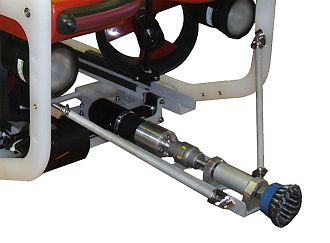
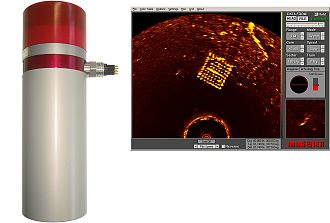
including cameras, sonars, tracking systems and a single
function manipulator. Custom designed under-slung modules can also be
added for task specific tooling. 316 stainless steel fittings are used
throughout. The core frame is manufactured using modern composite materials.
Buoyancy & Payload
Buoyancy and payload is provided by securing buoyancy blocks
of the appropriate depth rating to the chassis below an easily
removable hydrodynamic faring. The faring cover also provides
protection to electronics housings and cables routed along
the top of the buoyancy to the junction box. Mounting points
on the vehicle skids are provided for lead ballast to trim
the vehicle's centre of gravity and buoyancy.
 |
|
 |
| Falcon DR with faring cover in
place - note also the clear water path through the vertical
thruster |
|
Faring and forward buoyancy block removed
providing access to cables and ROV Junction Box |
Propulsion
Brushless DC thrusters have been used on all Seaeye ROVs since
1987 when the company first introduced this technology to
the offshore oil & gas industry. These thrusters have
drive electronics with velocity feedback for precise and rapid
thrust control. A fast PID control system and a solid-state
rate gyro for enhanced azimuth stability prevent overshoot
on a change of heading as well as helping stabilise the vehicle
in forward flight making the vehicle so easy to fly.
The Falcon MCT01 thrusters are magnetically coupled
and run cool without oil. Having no moving shaft seals they
are extremely low maintenance, reliable and ideal for use
in sensitive areas such as fisheries and on reefs.
The open frame and clutter free layout between
decks in the Falcon provides the clearest water flow to 4
horizontal vectored thrusters positioned for optimum thrust
and control in all directions and superior station keeping
in strong cross currents.

Falcons are powered by 5 Seaeye Magnetically
Coupled Thruster units (MCT1) each capable of achieving 13
kgf thrust at 320W or a combined forward thrust (bollard pull)
of 50 kgf. For an ROV weighing only 50 kilos this represents
an impressive 1:1 power to weight ratio.

MCT1 Thruster Performance
| Thruster Configuration |
| 4 Vectored Horizontal Thrusters |
| 1 Vertical Thruster |
| |

Uncluttered layout between
decks provides
optimum water flow
Distributed Intelligence Control System &
ROV Junction Box
The Falcon is the first ROV in its class to have a distributed
intelligence control system. This is a multi-drop network
that allows up to 128 devices to be connected together on
a single RS485 serial network and to be individually controlled
by a master processor.
Every controllable device on a Falcon, such as
thrusters, lights, camera tilt motor, navigation pod and manipulator
pod, contains its own microprocessor and interface and is
called a 'node'. Each of these 'nodes' is separately addressed
on the network and controlled by the master processor in the
Surface Unit. Every node is fully isolated to maximise system
reliability and each is connected into the vehicle junction
box PCB using a common through bulkhead connector. The JB
printed circuit board provides each node with its own fused
power supply and telemetry.
The Junction box also houses the video line driver
for Falcon and the F2 Fibre Optic Multiplexer for the Falcon
DR that is an optional upgrade for the standard system.
This use of distributed intelligence does away
with the traditional ROV electronics pod packed with interface
circuit boards and frees up space while significantly reducing
the weight of the vehicle.

Control System Diagnostics
Full system diagnostics are provided: A software routine automatically
checks each node when the system is powered up and alerts
are provided on the video overlay to warn the operator. The
full characteristics of each node can also be interrogated
individually from the surface unit. Local diagnostics are
also provided for each node in the Junction Box with colour
coded LEDs confirming fuse and telemetry status.
Camera System
A high resolution fixed focus colour camera is fitted to a
camera platform than can be tilted + 90 degrees. An additional
switched camera can added to Falcon and is usually mounted
on the underside of the camera tilt platform. The F2 Fibre
Optic Pack in Falcon DR - (optional in standard Falcons)
- provides 3 simultaneous video channels. Panning the camera
is achieved by turning the vehicle which it can do within
its own length.
| Standard Seaeye Colour
Camera Specification |
| Camera Resolution |
480 TVL |
| Min. Scene Illumination |
0.2 LUX (F1.4) |
| Pick Up Device |
1/2 Inch CCD Image Sensor |
| Lens |
1/2" Aspherical 3.8mm lens,
wide angle fixed focus |
| Horizontal Field of View |
91° |
| Tilt |
±90° |
| |
Lighting
Two forward facing variable intensity 75 watt Tungsten Halogen
flood lights are fitted. An optional additional light can
be added. The lights are powered at low voltage, to improve
reliability and longevity. In the Falcon DR the forward
facing lights tilt with the camera for improved scene illumination. LED lights are offered as an option.
 |
|
 |
Falcon DR tilting flood
lights are linked to the
camera tilt mechanism |
|
Standard Falcon with optional 3rd light fitted to the
camera chassis. Photo: courtesy of the
Underwater Centre Fort William |
Navigation System & Auto Functions
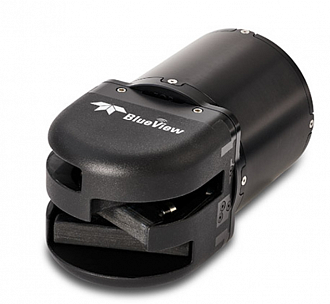
All navigation sensors and aids are housed in a single hardened
aluminium pod. Auto depth and heading are standard fit with
auto altitude offered as an option. A pitch and roll sensor
is included and may be selected for display on the video overlay.
| Specification |
| Compass Accuracy |
±0.5° |
| Depth Sensor Accuracy |
±0.5% of FSD |
| Gyro |
0.1 °/s |
| Surface Update Rate |
<40 mS |
| |

SURFACE EQUIPMENT
Input Power Requirements
Single Phase universal auto sensing, self selecting input
of 100-270 VAC at 2.8 kw.
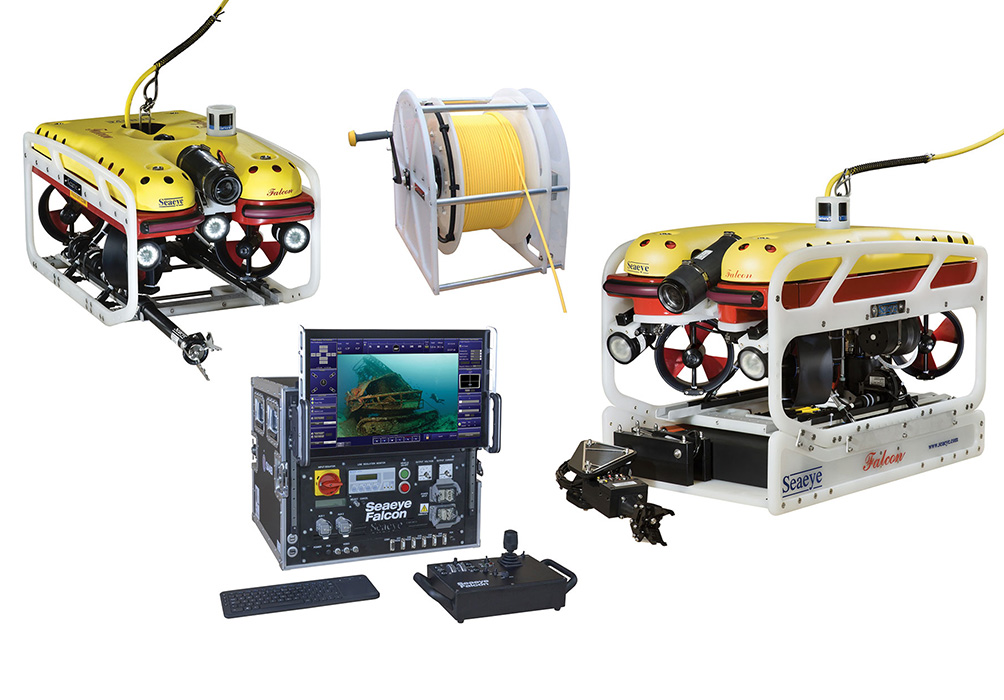
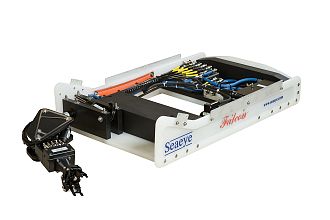
Falcon Surface Control unit
The Falcon and Falcon DR switch mode power supplies,
control system, fold out 15 inch LCD monitor and keyboard
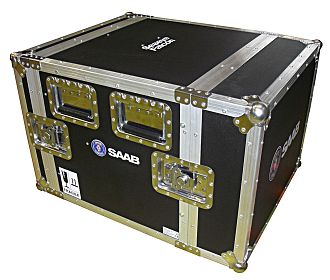
are installed in a 19 inch rack mount transport case.
 |
|
 |
| Seaeye
Falcon Control unit |
|
|
All connections to the surface unit are on the
front panel for easy access including the hand controller
with its 5 metre flying lead.
The power output from the surface unit to the
umbilical is a galvanically isolated 500 VDC supply protected
by a L.I.M.
Optional IP68 waterproof surface unit
 |
|
 |
| IP 68 monitor and controls |
|
IP 68 Power supply
unit |
IP68 is a waterproof standard
providing protection against water ingress following immersion
to a depth of 1 metre. This option is particularly popular
with military and security users operating from small boats.
Vehicle Controls on the
Hand Control Unit (HCU)
The following vehicle controls are provided on
the HCU:
- Single 3 axis joystick for horizontal vehicle control
including forward, back, sideways and turn.
- Rotary trim controller for vertical thrust up or down.
- Push button dive and surface control
- Thruster enable / disable and power setting
- Camera selection
- Rotary control for lights intensity
- Auto pilot function for both heading & depth.
- Auxiliary vehicle controls (including manipulator open/close)

Seaeye Falcon hand controller
& 5 metre lead
| Dimensions |
| Height |
180 mm |
| Width |
280 mm |
| Depth |
120 mm |
| Weight |
0.5 kg |
| |
Video Overlay
A video overlay system is incorporated as standard providing
the following information to the pilot:
- Compass heading
- Depth
- Camera tilt position
- Auto pilot function status
- Umbilical turns counter
- Vehicle pitch and roll
- CP reading
- Date and time
- Free Text using a QWERTY keyboard

F2 FIBRE OPTICS
The F2 Fibre Optic Pack is standard fit to the
Falcon DR and an optional upgrade for standard Falcons.
It provides the addition of a subsea and surface fibre optic
multiplexer and a suitable umbilical for transmission of video
and data over fibre optics between the surface and the vehicle.
The Benefits of the F2 Fibre Optic Package
include:
- 14 mm Low Drag twin pass Fibre Optic Umbilical
- Spare Fibre Optic pass
- 2 x RS 485 (1 spare) and 4 spare RS 232 bi-directional
channels
- 3 Simultaneous Video Channels
- Ability to use broadcast quality video cameras and/or
greater volumes of data over longer cables
- Extended ROV excursions to 1100 metres

UMBILICAL CABLES
For the standard Falcon a choice of neutrally
buoyant or thinner, slightly heavy umbilical cable is offered.
These light weight proprietary jacketed cables offer high
abrasion resistance and incorporate a Vectran strength member.
| Specifications - Standard Falcon umbilicals |
| |
5733 |
5736 |
5801 (with 1 additional Screened Twisted Pair) |
| Diameter |
11 mm |
14 mm |
16 mm |
| Breaking Strain |
530 kg |
530 kg |
530 kg |
| Weight in air |
121 ± 4 kg/km |
170 ± 5 kg/km |
209 ± 6 kg/km |
| Weight in seawater |
7 ± 4 kg/km |
7 ± 5 kg/km |
7 ± 6 kg/km |
| Minimum bend radius |
165 mm (dynamic) 110 mm (static) |
197 mm (dynamic) 131 mm (static) |
240 mm (dynamic) 160 mm (static) |
| |
For the Falcon DR and Falcons upgraded
with the F2 Fibre Optic Pack the following Fibre Optic umbilical
is used with a maximum length of 1100 metres (for longer excursions
custom designed umbilicals are available).
This cable features a tough abrasion resistant
Polyethylene inner and outer jacket with a torque balanced
vectran braided strength member. Internally this cable has
two multi mode fibre optic passes providing 100% redundancy.
| Specifications - Fibre Optic umbilical |
| |
5823 |
| Diameter |
14 mm |
| Breaking strain |
2000 kgf |
| Weight in air |
164 ± 5 kg/km |
| Weight in freshwater |
10 ± 5 kg/km |
| Minimum bend radius |
165 mm (dynamic) 110 mm (static) |
| |

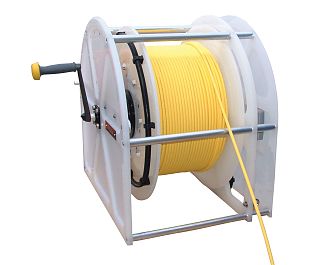
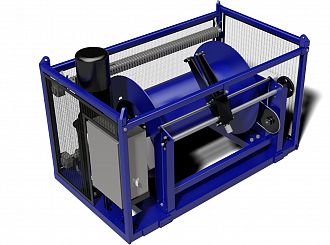
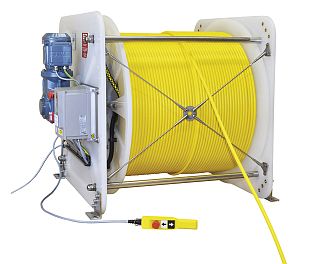
WINCH OPTIONS
A choice of hand operated winches are available
including a compact wheeled Pelican case housed winch that
can accommodate a useful 295 metres of 12 mm diameter umbilical.
Electric winches are available for the longest umbilical lengths.
All have appropriate slip rings to suit the umbilical type.
 |
|
 |
| 300 metre capacity hand
winch with 12 mm umbilical. Wheels and pull handle included |
|
450 metre capacity
hand winch (600 metre option with 14 mm diameter umbilical |

SEAEYE FALCON OPTIONS AND ACCESSORIES
For the full range of options and accessories click here.
SPECIFICATIONS MAY CHANGE WITHOUT PRIOR NOTICE
 |